return
to homepage
La
Guilde de la Blanchepierre
(The Guild of the White Stone)
In 1997
the painter and sculptor Van
Nielsen and I shared a studio in Austin, Texas. It was a white
stone house from the 1920's surrounded by ancient oaks in the
oldest part of town. I had several pieces of Carrara marble that I
had shipped over from Italy in 1994, and one of these sat on the
front porch for a couple of years, waiting for me to take chisel
to it. Van finally tackled it, covering the porch and yard with
shiny white chips. I also loaned him a small block of Yule marble
from Colorado, which he also peppered the front yard with, finally
discovering a nice torso within.
At about the same time, I
was reading a biography of Lewis Carroll. Carroll distinguished
very special days in his journal by giving them a white stone. His
boating party with Alice was one of these days, of course.
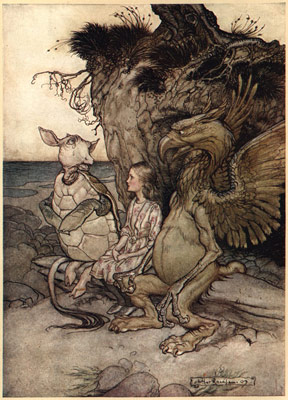
drawing by Arthur Rackham
In
the 1990's I also had an Alice. Her name was Tess, and I did some
50 drawings, paintings and sculptures of her in that decade. She
was seven when her mother, one of my agents, brought her over to
the studio by chance, and I understood that I had been sent a gift
by the Muse. You can see her all over my portfolio.
At any
rate, I realized what a lovely image the white stone was in
Carroll's biography, and also saw how the motif was repeating
itself in the environs of our studio. When Van and I decided to
form a guild and to start a small school in 1998, we tossed around
several ideas for a name. We liked the idea of a Brotherhood, but
decided it was a bit too Pre-Raphaelite, not to say unencouraging
to any women who might be up for Master status in the future. We
also played with some synonyms of "renaissance" and
"rebirth" (like everyone else). The best was probably
The
Recurrence,
giving a nod to Nietzsche. But this was not memorable enough. A
bit vague. The term I had used for my first book on
counter-criticism, Zeitgeber,
was dismissed as too hard to pronounce. It was already stretching
it to use it as a non-German book title; as the name for a
movement it was a little too arcane. We needed something just odd
enough to catch in the mind and in the eye of the intellectual,
but not so odd that it just ricocheted off the mind of the public.
Spanning this bridge is not as easy as one would think, and many
will think we still haven't managed to cross the water without
getting a dunking. I suppose only time will tell. Who would have
thought that fairly normal people would get used to saying
"Pre-Raphaelite Brotherhood"?
I have remained
adamant about keeping the French title, rather than just the
translation (although both are nice), because I feel that French
is somehow less intimidating than German, even to Americans who
don't know a word of either. Some will recognize the "zeit"
from zeitgeist,
and so Zeitgeber
will not be totally unfamiliar. But Blanchepierre is even more
familiar, since most know that blanche
means white. Pierre is equally familiar as a guy's name. Beyond
this, blanchepierre
is just one of those words, so common in French but uncommon in
German, that rolls off the tongue. You get a feeling that it is an
artistic word even if you don't know what it means. It is like
blanchefleur
(white flower): a word just made for Troubadours. In fact,
blanchepierre
didn't occur to me until I was researching Tristan
and Isolde
and ran across the name Blanchefleur in the knightly tales.
Van
and I finally settled on the name after a trip to Bruges, Belgium
(where I now live). Bruges is actually Flemish, not French, but it
is the Medieval city nonpareil, the stones still exhaling the
ghostly breath of Jan van Eyck and Hans Memling, and of pale
maidens draped and hooded. These ghosts haunt the foggy canals at
night in the forms of white swans, shining dully in the
gloom.
Even now, the imprint of the French is strong in
Bruges. The College of Europe in Bruges teaches in French and
English, not in Dutch or Flemish. So if we have chosen French for
our guild, you will have to forgive us. Besides, the Flemish does
not have quite the same poetic appeal: De
Gilde van de Witsteen.
Addendum:
Several readers have written in asking about a manifesto for the
guild. This is my answer to one of them.
I feel it is
almost redundant to publish a manifesto since everything I have
written (and that is lot) could be seen as a manifesto of sorts.
No one with any curiosity can be confused about how I stand on
just about any issue related to art. Besides, I have a kind of
aversion to manifestoes. There is something unforgiveably
claustrophobic about them. I don't know why. An art guild is
always little more than a name and a group of works anyway. If the
works don't express the movement, nothing will. Besides, all my
writing is not really a manifesto, it is a defense. My writing is
not the creation of a theory, but the destroying of all theory
that gets in my way as an artist.
Those who really need a
manifesto can use my introduction on my homepage as one. There I
throw down the gauntlet as well as anywhere.
Click
here to read an article on the precursor to the Guild of the
White Stone, the Pre-Picassan Brotherhood. This was the working
name of the guild in 1999, when Laura Alport wrote this article
for a local paper. She was told the language was too "avant
garde" and it was never published. Ironic that.