|
|
return
to homepage
{First published in Taos
Magazine, August 1993}
The
Sad Beauty
At
Quast Galleries, Taos, works by Miles Mathis
revive the
tradition of realistic figure painting
by Gene
Beckwith
In
the French film Tous les Matins du Monde (All the Mornings
of the World), the baroque cellists St. Colombe and Marais,
trying to come up with a reason for their art, can only say, “One
must leave a drink for the dead.” The Japanese have a word for
this languishment as artistic motivation, this obsession with the
passing of time—they call it mono no aware, the sad
beauty. It is this beautiful sadness that inspires the work
of Miles Mathis.
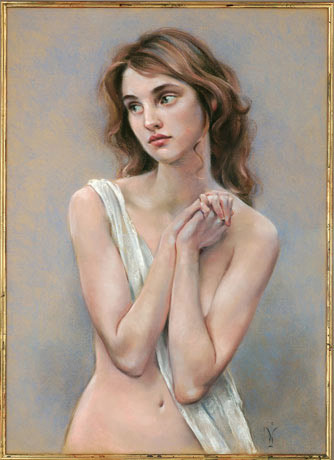
Working
in the classical tradition, Mathis is an accomplished draftsman.
His handling of paint is tightly modeled, its effects subservient
to the illusion of surfaces and textures rendered. “The
painting,” he insists, “must be more important than the
paint.” His use of chiaroscuro is reminiscent of
Caravaggio’s—dramatic and mysterious plays of light at once
cloak and reveal. Silent shadows and frank lighting heighten the
emotional tenor of the work. Mathis explains, “For me, bright
light chases away all depth—whether it is the physical depth of
three-dimensionality or, more importantly, the depth of
emotions.”
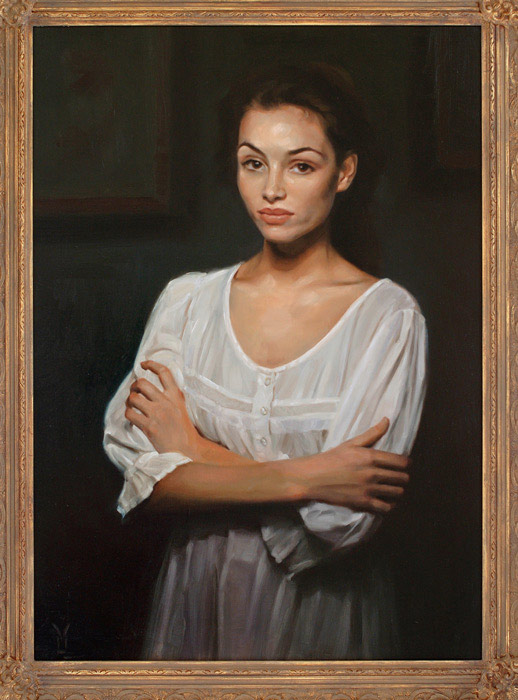
In
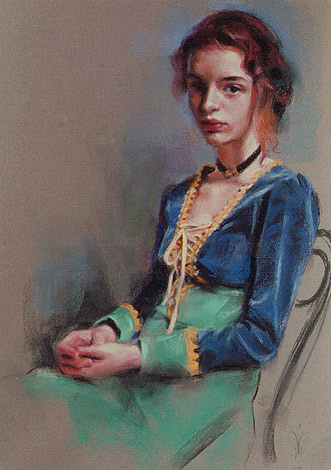
depicting these emotions, Mathis uncovers remarkable nuances of
gaze and gesture, of mood and spirit. His intimate portraits of
young women and girls are appealing for their honesty and
simplicity. “Most of my work does represent a certain age. You
could say my subjects are innocent, yes. But I prefer the
adjective ‘ingenuous’. It conveys the idea of a physical and
psychological presence that is uncorrupted. It is an innocence
that has nothing to do with being, or not being, sexual.”
The
beauty and allure of Mathis’ women is subtle but mesmerizing.
These faces and figures are not classically idealized archetypes;
they are not overtly seductive nor cloyingly sentimental. Through
a range of feelings, these portraits finally elicit an uncanny
and complex sense of intimacy, involving subject, artist, and
viewer. “I often think that I am attracted to a different kind
of beauty—a feminine gravitas,” he says. “After all,
it is not only men who can have a strong or ‘weighty’
presence. The women I paint are intelligent and possess this
intangible or ineffable quality—as if they know something I can
never know.”
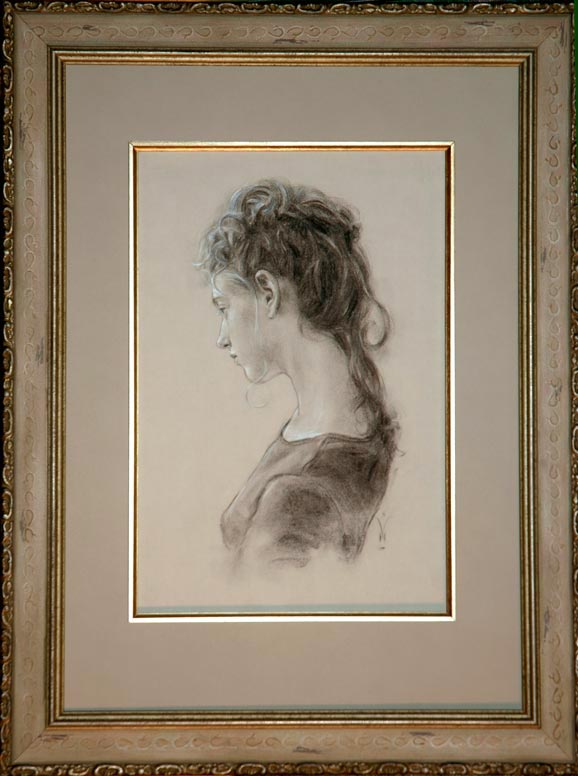
Mathis is
indefatigable in his pursuit of excellence—he may spend as much
time with a charcoal drawing as with an oil painting, for
instance. He works in all the traiditonal media, including
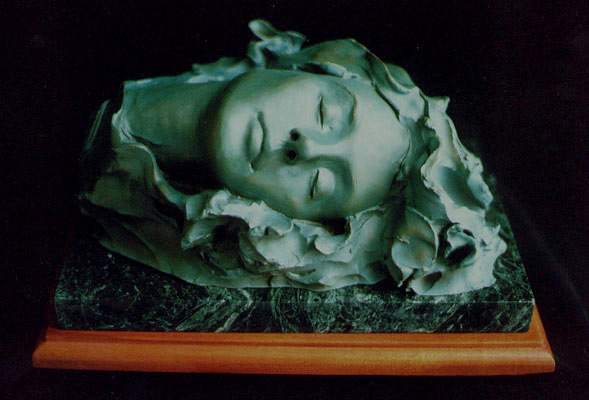
watercolor and pastel, and he has recently added the sculptural
media of terra cotta, bronze, and marble. A trip to Italy in
March yielded 900 pounds of Carrara white marble to his
inventory. His galleries, he says, can expect some
three-dimensional work by Christmas.
Mathis
is a National Merit Scholar who graduated Phi Beta Kappa
with a degree in philosophy from the University of Texas at
Austin. To pursue a career in fine arts he gave up a full merit
scholarship to attend a two-year Masters program in politics and
management. He is still committed to his study of art history,
art theory, and art education. Currently he is working on a book
of art instruction that addresses many issues of art beyond style
and technique, including an informed attack on the tenets of
Modernism. Mathis writes, for example, “Self-expression and
novelty are all that remain of the tools of the modern artist,
but no one thinks to ask whether the new ideas being expressed
are well-informed, interesting, beautiful, or (heaven forbid)
true. Nor does anyone demand that his art which is only
self-expression be well-expressed. Much of contemporary
expressive painting must be explained verbally (by an agent,
dealer, or critic) which doesn’t say much for its
expressiveness….
“The
great artists of the past are remembered because they managed to
create works of beauty and power while living in a world that was
just as crass and illiterate, mercenary and shallow, as ours.
They managed this because they recognized, and deeply felt, not
only this senselessness, degradation, and squalor, but also, and
more strongly, the astounding beauty, complexity, and meaning the
world around them.”
As
for his connections to the Southwest, Mathis, a Texan, says,
“When I was very young, my family used to spend summer
vacations in Sipapu, and I’ve never forgotten the smell of the
pines, the coolness of the air. Every visit to Taos brings back
those memories, but my attraction is not only nostalgic. I could
very easily see myself living in the mountains in a few years.”
If this paper
was useful to you in any way, please consider donating a dollar
(or more) to the SAVE THE ARTISTS FOUNDATION. This will allow me
to continue writing these "unpublishable" things. Don't
be confused by paying Melisa Smith--that is just one of my many
noms de plume. If you are a Paypal user, there is no fee;
so it might be worth your while to become one. Otherwise they
will rob us 33 cents for each transaction.
|