|
return to 2003
The
Value of Copywork
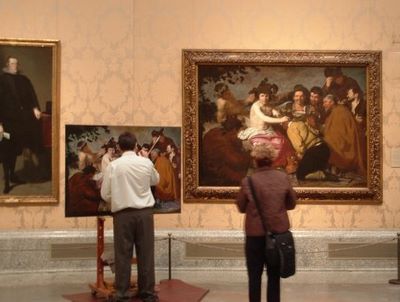
by Miles
Mathis
Until about
90 years ago, museum copywork was an integral part of the
education of every young painter. Depending on whether you
were French, Spanish, or American, a sojourn at the Louvre,
Prado, or Metropolitan would have been considered de rigueur.
Those lucky enough to have wealthy parents, patrons, or sponsors
might even have traveled outside the country to find the great
works of the past (Italy was, of course, a favorite
destination). But the advent of Modernism changed all
that. From where we sit, with our simplifying hindsight, it
appears that at the very moment Picasso left his Rose Period, an
historical lifeline that even the Impressionists and
Post-Impressionists respected was cut. The past was no
longer the residence of giants upon whose shoulders we might
stand (to paraphrase Isaac Newton). Instead it became a
dustbin, and our success as artists became measured by how
quickly we could relegate our fathers and teachers into it, and
how long we could stay out of it.
But artistic
indebtedness was not a sin until the present century:
Michelangelo was heavily indebted to the Greeks; Rubens was
greatly influenced by Michelangelo; Van Dyck copied Titian; the
Spaniard Velasquez studied the painters of the Italian
Renassiance, especially Caravaggio, and influenced European
painting from Goya to Manet. The American William Merritt
Chase copied Velasquez in his youth, and John Singer Sargent
copied Velasquez as well as the Dutch painter Frans Hals.
And what would Rodin have been without Michelangelo before him?
In twentieth-century America, the influence of these Old Masters
is still felt, but "art history", so called, has gone
elsewhere. And it is this "elsewhere" that shows
most clearly, I think, that those with the fewests debts also
have the fewest assets.
Now, after
decades of neglect and abuse, classical painting—and copywork
along with it—has seen its ebb-tide and is preparing, one
hopes, for a resurgence. There has been an historical break
that is not easily remedied. But our museums remain a
repository of information and ideas—some them obvious, some
esoteric. In this article I hope to inspire others to
discover for themselves the great wealth that history still
offers those wise enough to seek it. Museums and libraries
have been my classrooms—places where I could research from the
primary source, where I could work mano a mano, literally
hand to hand, with the great artists of the past. Like the
Protestant Reformation, copywork is a return to direct
inspiration, perhaps not divine, but nearly so. One can
remove all intermediaries—teachers, critics, editors, dealers
(the clergy of aesthetics)—and decide for oneself the
importance of Rembrandt or Raphael, Murillo or Zurbaran, Vermeer
or Van Dyck. And by purchasing your education wholesale, as
it were, you will find that you have also saved time: the more
you can control your own progress the more personalized it will
be, and thus the more efficient. You know, for example,
where your strengths and weaknesses lie. You probably have
very specific questions the anwers to which would shore up these
weaknesses, but no one will tell you what you need to know.
Perhaps no one can. The trick is to find someone who
does know and to pry it out of him. The best place to beg
for technical secrets is at the museum, because the artist cannot
say no. You set up your easel, and in the process of
imitation you begin to understand the process of creation.
The information is not told to you; it is intimated, sublimated.
Copywork is truly learning with the right side of the brain, for
the technique is not rationalized but intuited. And since
painting is a capacity of the right-brain, the experience can be
felt directly without the interference of the rational
left-brain. This is important, for the left-brain is an
intermediary just as insidious as the art critic. The great
left-brain—master of technology, statistical wizard, birthplace
of economics, prime-mover of the modern age—and sour scourge of
art. Resist the temptation to overanalyze your work and you
will have taken a giant step toward discovering your Muse.
But before
you discover your Muse, you must first discover your mentors.
By reading widely you can find the artists you most admire.
These artists will teach you to paint: then and only then, if you
are lucky, your Muse will teach you to create.
Once you
have discovered a mentor—an Old Master who inspires you,
say—your first step is to find a book about that artist.
You should look for a recent publication with as many color
photographs as possible. You can buy a book at the
bookstore, of course, or you can do your research at the public
or university library. If you live in a college town, I
highly recommend the fine arts library at the university.
The bookstore will have a few of the newer publications (which
are lovely if you can afford them), but the university library
will have a much larger selection, and you are more likely to get
all your work done in one place. Unless you are also a
student, you won't be able to check anything out, but since you
will just be doing research this won't really matter. Next
to the photographs in the book (or in an index at the back) will
be listed where the original work is located. This is more
likely to be correct and up-to-date in the more recent
publications. Works listed as being in museums are less
likely to have relocated because of a recent sale than works in a
private collection, but always call before you make a long road
trip to copy a particular work. Those works still owned by
individuals may be listed as being in "private collections",
with no specific information included. But some will list
the owner's name. These works are not off-limits to you.
If the owner is nearby, give him or her a call. It may be
possible, depending on the person, to at least view the work.
Many connoisseurs are quite happy to find someone interested in
their collections. If, during the meeting, you develop a
rapport with the owner, you may be able to get permission to
copy. Usually, though, it is much easier to make an
appointment to copy with a museum, which is open everyday, than
to deal with an individual who will have many other demands on
his time. The best thing is to find a beautiful work in a
museum nearby. Reasearching a number of artists at once
will increase your chances of finding an inspirational work.
If you find,
despite your best efforts, that all your mentors' works are in
London or Madrid or St Petersburg, for example, remember that
almost every major city has a museum of fine art. You will
be surprised at what masterpieces many of them have, especially
in storage. In order to discover exactly what these museums
have, it is necessary to find a catalog of the complete
inventory. Again, the library will have many of these.
Or you can send off to the museum for a catalog. You will
probably find that the museum just up the road has a number of
pieces that interest you.
In choosing a work, it is
important to keep in mind what you are trying to learn.
This will vary from trip to trip, but constantly reassessing your
own development will help you choose works that are likely to
answer questions you need answered now. Especially, do not
overreach yourself. It is important that each session be a
positive one. For me, I find it helps to isolate a single
problem and to concentrate on an area in a painting that can be
copied in one day. For instance, with John S. Sargent's
Venetian Beggar Girl (Dallas Museum of Art),
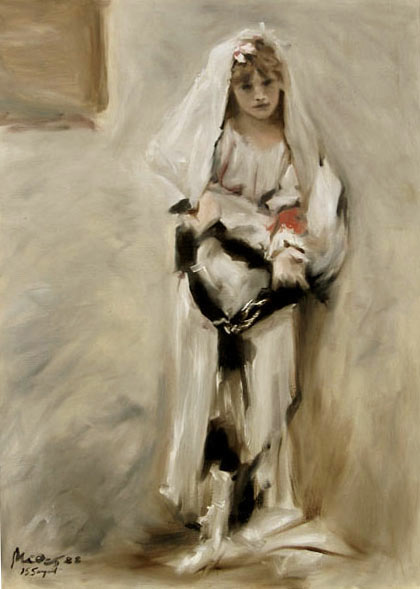 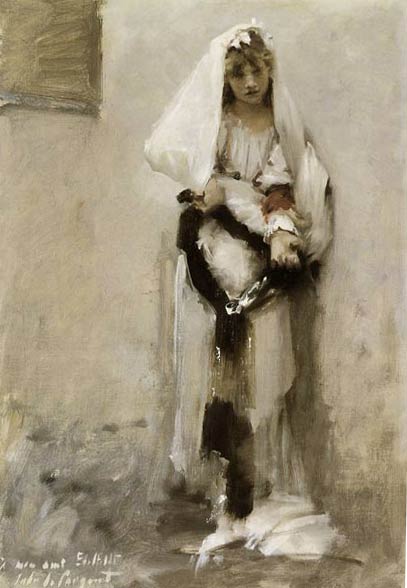
click for detail
I was
interested in the overall looseness of the brushwork. I did
this copy very soon after beginning to use oils and my goal was
to learn to handle a brush the way Sargent did. Therefore,
the small scale of the painting (24 by 18) and its nearly
monochromatic palette allowed me to isolate brushwork as my
exercise. It also allowed me to have a complete painting at
the end of four hours—a painting that I would always have as a
reminder of what I knew and how I knew it.
A couple of
years later I went back to Sargent (Carnation, Lily, Lily,
Rose, Tate Gallery, London)—this time for color.
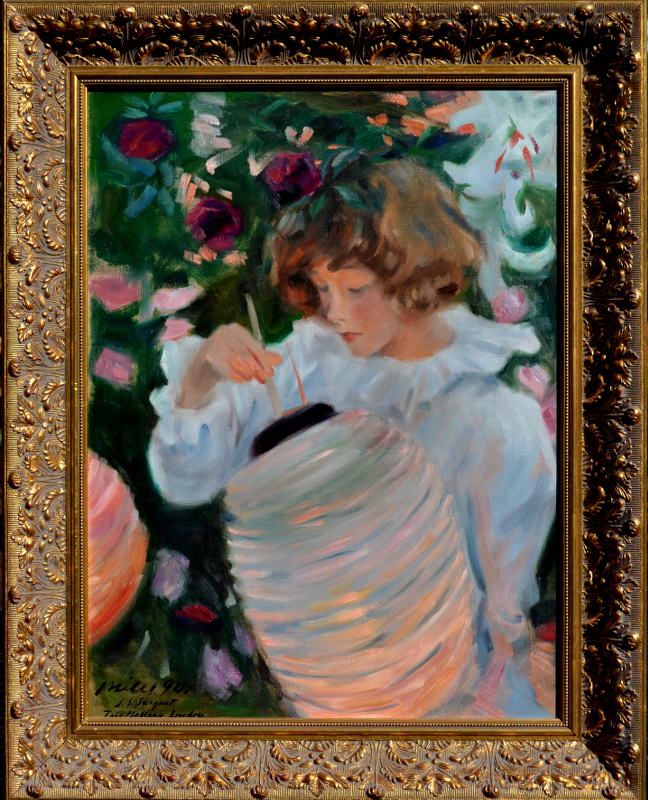
Again,
I chose an area I could copy at one sitting—in this case about
a quarter of the painting. I was interested in the way
Sargent had worked the little girl into the background, not with
detail, but with bright yet unexaggerated complementary colors,
especially orange and green.
At about the same time, I did
a partial copy of Bouguereau's Admiration (San Antonio
Museum of Art).
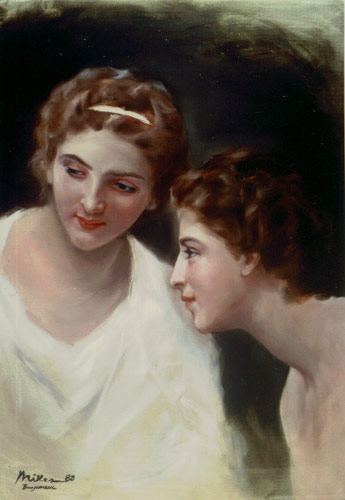
Once again,
the canvas is 24 x 18, and I worked for about four hours.
This gave me time to bring the skintones to a fairly high degree
of finish. Since Bouguereau used minimal glazing or
overpainting in his faces, this is all I needed. The trick
to copying a Bougeureau, I discovered, lay more in the choice of
undertone, the absorbency of the canvas, and the choice of white
to use as the base skintone. I had the wrong white, which made
it impossible to match his style no matter what else I did.
Of course,
you may plan an exercise that can't be completed in one sitting,
but I find that many of those who spend weeks and months exactly
copying large detailed works lose the ability to treat the
experience as an exercise. It instead becomes hero
worship—replication rather than the passing of a torch.
This should be avoided at all costs. I might mention,
however, that you should not be afraid of being unoriginal or
derivative while you are learning to paint. All of us who
learned to play chopsticks on the piano as children were not
derivative. We were simply young. You must allow
yourself to go through a learning phase where you are not very
good and not very inventive. Because to become good and
inventive you must first learn to paint. To again use the
musical analogy, if you want to write music you have to learn the
scales. If you want to paint you must first become
technically proficient at applying paint to the canvas.
This is simply a fact.
Once you have
chosen a work to copy, the next step is to contact the museum.
Sometimes you can get all the information you need over the
phone. Unfortunately, just as often you get the run
around. Copywork is rare outside of New York City, Chicago,
and Washington, D.C. (and it is rare in these places, now, too),
and an administrator or curator at a smaller museum may not know
his museum's policy of admission. You may be told that
copywork is not allowed when in fact it is. Don't give up
until you have written a letter to the director stating that you
are a student (you don't have to be enrolled anywhere or look
eighteen) and that you are copying for your own edification (as
opposed to copying for resale). This should get you in.
If you are
interested in copying a work in storage, you will need to get
special permission from the director or curator. An
appointment will have to be made to give the museum time to find
the work and to prepare it for copy. All museums should
have public access to stored works, provided you make an
appointment well in advance. Some will require references.
But, of course, actual policy will vary depending on the museum.
For instance, the Kimbell Art Museum in Fort Worth, despite being
a first-rate collection, allows no copywork, ever. This is
unfortunate, for it displays not only a large gap in commitment
to public service, but also a forced break in the history of art:
if the young artists of today can't learn from the past, what
will fill the museums of tomorrow? If you encounter other
such instances, I encourage you to complain vociferously.
It is just another example of how our artistic heritage, and the
past in general, is being entombed.
Now, some specific
recommendations:
Always take
an assortment of canvases. You may change your mind about
what to copy once you see the complete collection, or decide to
copy more than one painting. Also, museums rarely let you
copy at the same size as the original: you either have to
copy a detail or blow the full-size canvas up or down by two or
three inches. So build your canvases accordingly.
If you are
copying a work painted before 1900, it helps to have your canvas
already toned (to about the color of raw linen). White
grounds were not used much before the present century. I
have found that the color of the ground is usually not as
important as its value (its darkness). Just throw a
turpentine wash of raw umber or some other mid-tone over your
white canvas. If you paint on a white canvas, it will be
hard to match your values to a painting on a toned ground.
Also, I highly recommend you use white lead as your ground when
copying old works. If you want to match their
effects, you must match their supplies, and I assure you that
none of them were painting on acrylic gesso. If you are
lazy, you can always paint a thin layer of white lead right over
the top of your pre-stretched gesso, and then tone it. This
gives you a quick fix, and provides a ground with less
absorbency. Your brush is then more likely to skate nicely
across your canvas like the old masters.
Always take a
clean cloth tarp to put under your easel. The museums are
not impressed by a dirty tarp, because they have no way of
knowing whether all the paint on it is dry or not. So take
a clean tarp large enough to cover the floor under you and your
easel. That way you can put your paint box on the floor,
and with your palette on your arm the only furniture you need is
your easel.
Invest in a
sturdy collapsible easel. Only the major museums (like the
Metropolitan) furnish an easel. I recommend a sturdy wooden
easel with three collapsible legs. Daniel Smith has a nice
one that is not very heavy for about ninety dollars. It is
much lighter than a "French" easel, and if you are not
a watercolorist you don't need the trays and the horizontal
capability. Obviously, if you are copying a watercolor, you
may want to spend a little more for the French easel. [But
be forewarned that most museums do not allow copying in
watercolors. Water is a greater danger to old paintings
than even oil paint—which can be easily removed with turps.]
It goes without saying that you can also build an easel, but
sometimes the hardware is hard to find. I have never built
a portable easel, but I did build my studio easel, and the
hardware for it could not be had for love or money. I ended
up "borrowing" the hardware from a broken easel that
had been pitched out into the courtyard of the art building at
the university. As artists we must be creative in so many
ways.
Take a paper
bag or a piece of cloth to wrap your used brushes in. You
don't want to have to clean all your brushes at the museum.
Take a small
box of pastels and conte crayons. If the museum absolutely
refuses to give you permission to paint, you can almost always
draw instead. For some exercises this is just as good.
When I copied Sir Anthony Van Dyck's Corneliis van der Geest
(National Gallery, London) I couldn't get permission to copy in
oils on the same day.
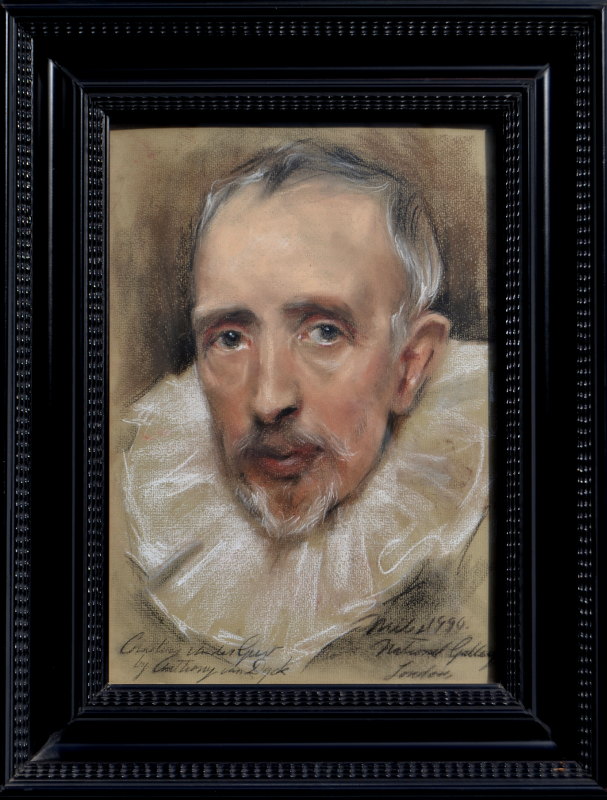
I was in a hurry, so I did a drawing instead. Since
I was interested in how Van Dyck had captured the old man's
character through lighting, detail, and color, pastels worked
very well.
Finally,
don't forget the importance of drawings. Drawing is not
only the basis of painting, it is also an exercise worth doing
for its own sake, or for the sake of beauty. And unlike
paintings, drawings can be copied with a great deal of success
from photographs in books (especially charcoal and pencil
drawings). Line quality can be copied and learned both for
its own sake and as it relates to brushwork. Developing
expressive line quality will help you develop expressive
brushwork. In copying drawings, choice of paper is very
important. You must match the texture very closely in order
to match the line quality. In this the only tools you have
are intuition and trial and error. I matched the effect of
Peter Paul Rubens drawing Daniel in the Lion's Den
(National Gallery, Washington, D.C.) with a sheet of
Japanese Kitakata that I first dusted with charcoal and rubbed
heavily to effectively "antique" it. Then a piece
of willow charcoal, fairly well sharpened, gave me the line
quality I wanted.
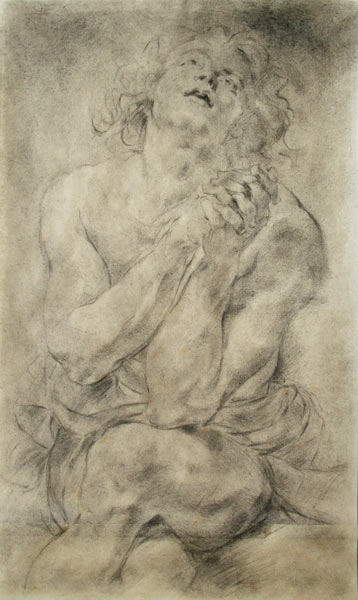
Copying teaches you the importance of the surface and
tools in creating an effect, whether with charcoal or paint.
Matching brushwork is more than just loosening or tightening your
wrist, for example. In copying an artist like Sargent you
must have fairly oily paint and a very smooth, non-absorbent
canvas. Whereas if you wanted to copy the great Russian
painter Nicolai Fechin, you would have to blot all the oil out of
the paint and use a canvas with more tooth. You would also
have to give up your filbert for a bright and a painting knife.
Learning these technical aspects can save you much frustration.
Many students blame themselves for lack of skill where the only
problem is incompatible paints, brushes, canvases, and desires.
Remember,
too, that technique is just a tool. Once you have mastered
technique, then you must teach yourself to create. This you
can learn from no one. The ultimate goal is to justify your
technique by putting it in the service of your ideas, and to
attain a level where these ideas have a quality all their own.
In the end, what one learns from the masters that is most
important is that great artists are not just virtuosos or
brilliant technicians. Nor, as we have had ample evidence
in the 20th century, are they simply groundbreakers, visionaries,
or ideamen. History teaches us that they must be both:
masters of an expressive medium with ideas of a depth and
sophistication worthy of expression.
If this paper was useful to you in
any way, please consider donating a dollar (or more) to the SAVE
THE ARTISTS FOUNDATION. This will allow me to continue writing
these "unpublishable" things. Don't be confused by
paying Melisa Smith--that is just one of my many noms de
plume. If you are a Paypal user, there is no fee; so it might
be worth your while to become one. Otherwise they will rob us 33
cents for each transaction. If the link below is broken, donate
through the kitty on my front page or updates page.
|